

.png)
.png)
Palm Springs Mortgage Rates 2026 | Buy Now or Wait?

Paul Kaplan
I've made it a professional goal to be known as a leader in the real estate industry in the Palm Springs market for the past 25+ years...
I've made it a professional goal to be known as a leader in the real estate industry in the Palm Springs market for the past 25+ years...
How Palm Springs homebuyers can take advantage of a changing real estate market, negotiate seller concessions, and potentially lower their mortgage payments without waiting for interest rates to fall.
If you've been dreaming of retiring in Palm Springs, purchasing a winter vacation home in Rancho Mirage, downsizing to a low-maintenance condo in Palm Desert, or relocating to the Coachella Valley, today's higher mortgage interest rates may have you putting those plans on hold. But is waiting for lower interest rates really the smartest decision?
With more homes available for sale, slower real estate sales, and sellers becoming increasingly willing to negotiate, today's Palm Springs real estate market may offer opportunities that buyers haven't experienced in years. While mortgage rates are an important consideration, they're only one part of the homebuying equation. In fact, negotiating the right purchase terms could potentially save you more money each month than simply negotiating a lower sales price.
At The Paul Kaplan Group, our Palm Springs real estate team works with buyers throughout Palm Springs, Rancho Mirage, Palm Desert, Cathedral City, Indian Wells, and La Quinta. One question we're hearing more frequently is whether buyers should purchase a home now or wait until mortgage interest rates decline.
The answer isn't necessarily as simple as waiting for lower rates. Let's look at what's happening with mortgage rates in October 2026, how higher borrowing costs affect homebuyers, and why today's changing Coachella Valley housing market could actually work to your advantage.
How Much Have Mortgage Interest Rates Increased Over the Past Two Years?
Mortgage interest rates have climbed considerably from the historically low levels experienced during the pandemic, and recent increases have added new challenges for homebuyers.
According to Freddie Mac's October 8, 2026 survey, the national average interest rate for a 30-year fixed-rate mortgage was approximately 7.40%, compared with 6.32% in October 2024 and 6.30% in October 2025.
That represents an increase of approximately 1.08 percentage points over the past two years.
For homebuyers considering a $1 million home in Palm Springs with a 20% down payment, that difference is significant. On an $800,000 mortgage, an increase from 6.32% to 7.40% raises the monthly principal and interest payment by approximately $560.
Over a year, that's roughly $6,700 in additional mortgage payments.
Higher interest rates affect how much buyers can comfortably afford, especially retirees and second-home purchasers who may be working with a fixed monthly budget. But borrowing costs are just one factor to consider when purchasing real estate in the Coachella Valley.
Will Mortgage Interest Rates Go Down in 2027, or Could They Go Even Higher?
Trying to predict future mortgage rates is difficult, even for economists and financial professionals. Interest rates are influenced by inflation, Treasury bond yields, the overall economy, and investor expectations. While Federal Reserve policies influence borrowing costs, the Fed does not directly control 30-year mortgage rates.
Mortgage rates could decline in 2027, but they could also remain elevated or increase further. There are no guarantees.
If rates do drop significantly, we could see another shift in the Palm Springs real estate market. Buyers who have been waiting on the sidelines may suddenly decide it's time to purchase, creating more competition for desirable homes.
That could be especially noticeable among buyers searching for architecturally significant mid-century modern homes in Palm Springs, luxury properties in South Palm Springs, golf course homes in Rancho Mirage, or desirable retirement communities throughout the Coachella Valley.
When more buyers return to the market, sellers may become less willing to negotiate. Homes that currently have longer marketing periods could begin selling more quickly, and buyers may find themselves competing with multiple offers.
The real question isn't just whether mortgage interest rates will go down. It's whether waiting for lower rates will actually put you in a better financial position when you finally purchase.
Is Palm Springs Becoming a Buyer's Market in 2026?
One of the most encouraging developments for homebuyers is the changing balance between buyers and sellers in the Coachella Valley housing market.
After several years of limited housing inventory and intense competition, buyers have more properties to choose from and, in many situations, more negotiating power.
September 2026 housing market reports showed approximately 2,765 homes available for sale throughout the Coachella Valley, representing roughly 4.5 months of inventory. Home sales were also approximately 34% below historical September averages.
While these conditions don't necessarily mean every Palm Springs neighborhood has become a buyer's market, they suggest that buyers have opportunities that were much harder to find during the peak of the pandemic housing boom.
A seller whose home has been on the market for several months may be more willing to negotiate the purchase price, contribute toward closing costs, make repairs, or provide concessions that help lower a buyer's mortgage payment.
For someone looking to purchase a Palm Springs vacation home, retire in Rancho Mirage, or relocate to a 55-plus community in Palm Desert, this flexibility can be extremely valuable.
Rather than focusing exclusively on finding a home at a lower purchase price, buyers should also consider negotiating favorable financing terms.
How Can Palm Springs Homebuyers Negotiate a Lower Mortgage Interest Rate?
Most homebuyers automatically think about negotiating the asking price when making an offer. But another strategy worth discussing with your mortgage lender and Palm Springs real estate agent is negotiating a seller-paid mortgage interest rate buydown.
A mortgage rate buydown allows a buyer to pay an upfront fee to the lender, often referred to as discount points, in exchange for a reduced mortgage interest rate.
Depending on the lender, loan program, and purchase terms, buyers may be able to negotiate for the seller to contribute toward these costs.
For example, instead of asking a seller to reduce the price of a home by $50,000, a buyer might negotiate for a seller credit that can be applied toward eligible mortgage discount points and other financing expenses.
Both options could represent a similar financial concession from the seller, but the impact on the buyer's monthly mortgage payment can be very different.
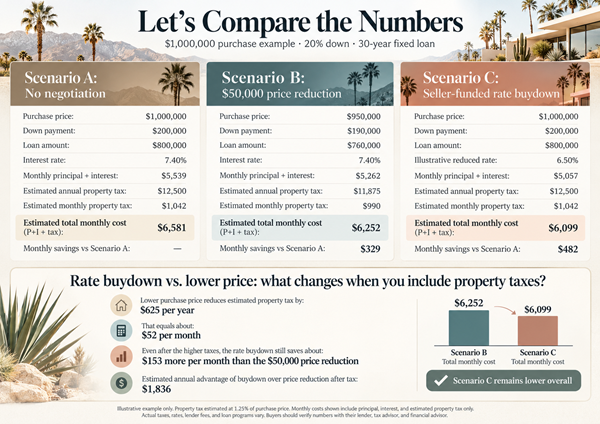
Let's compare the numbers.
Is a $50,000 Price Reduction Better Than a $50,000 Mortgage Rate Buydown?
Imagine you're purchasing a $1 million home in Palm Springs. You plan to make a 20% down payment and obtain a 30-year fixed-rate mortgage.
For this example, we'll use a starting mortgage interest rate of 7.40% and compare three possible scenarios.
Scenario 1: Purchase the Home at the Full Asking Price
Purchase price: $1,000,000
Down payment: $200,000
Mortgage amount: $800,000
Interest rate: 7.40%
Monthly principal and interest payment: Approximately $5,539
Scenario 2: Negotiate a $50,000 Reduction in the Purchase Price
Purchase price: $950,000
Down payment: $190,000
Mortgage amount: $760,000
Interest rate: 7.40%
Monthly principal and interest payment: Approximately $5,262
Monthly savings compared with Scenario 1: Approximately $277
Annual savings: Approximately $3,324
Scenario 3: Negotiate a Seller-Funded Mortgage Rate Buydown
Purchase price: $1,000,000
Down payment: $200,000
Mortgage amount: $800,000
Illustrative reduced interest rate: 6.50%
Monthly principal and interest payment: Approximately $5,057
Monthly savings compared with Scenario 1: Approximately $482
Annual savings: Approximately $5,784
In this hypothetical example, negotiating a mortgage rate reduction to 6.50% would lower the monthly principal and interest payment by approximately $205 more than negotiating a $50,000 purchase price reduction.
Over ten years, that represents approximately $24,600 in additional mortgage payment savings compared with the lower-price scenario, assuming neither mortgage is refinanced or paid off early.
These figures illustrate why homebuyers shouldn't automatically assume that negotiating a lower purchase price will produce the greatest monthly savings.
However, there's an important consideration: a seller contribution of $50,000 does not automatically guarantee a mortgage rate of 6.50%. Actual rate reductions depend on lender pricing, loan programs, market conditions, applicable limits, and the specific terms offered by the lender.
There are also differences in the buyer's down payment, the original loan balance, future equity, property taxes, and the potential benefits of refinancing. These factors should be evaluated when determining which option offers the best overall financial outcome.
How Much Can $50,000 in Mortgage Discount Points Actually Lower Your Interest Rate?
Mortgage discount points are typically calculated as a percentage of the loan amount. One point equals 1% of the mortgage.
On an $800,000 mortgage, one discount point would cost $8,000. A $50,000 contribution would equal 6.25 points if all the funds could be applied toward discount points.
As a general illustration, one point may lower a mortgage interest rate by approximately 0.25 percentage points, but this varies considerably. Lenders do not necessarily offer proportional rate reductions for additional points, and some may limit the amount that can be purchased.
For the example above, a mortgage rate of approximately 6.89% on an $800,000 loan would produce nearly the same monthly principal and interest payment as purchasing the home for $950,000 at 7.40%.
A lower rate could create additional monthly savings.
However, whether that rate is available, how much it costs, and whether the seller can contribute the requested amount must all be verified with the buyer's mortgage lender.
Certain conventional loan programs may permit seller financing contributions of up to 6% for eligible primary residences and second homes with a 20% down payment. Different limits apply to investment properties and other financing programs, and seller credits cannot always be used entirely for discount points.
An experienced mortgage professional can help compare several options to determine which financing structure makes the most sense.
In some situations, a combination of a smaller price reduction and a seller-paid rate buydown may provide a better result than either strategy alone.
What Is a Temporary 2-1 Mortgage Rate Buydown, and Could It Help You Buy a Palm Springs Home?
Another option available through some lenders is a temporary mortgage rate buydown, commonly called a 2-1 buydown.
Unlike a permanent mortgage rate buydown, which reduces the interest rate for the life of the original loan, a temporary buydown provides payment relief during the first few years.
For example, if your permanent mortgage interest rate is 7.40%, a typical 2-1 buydown could reduce the payment calculation to the equivalent of:
Year 1: 5.40%
Year 2: 6.40%
Year 3 and beyond: 7.40%
The temporary reduction is funded through an upfront subsidy, potentially paid by the seller as part of the negotiated purchase agreement.
This strategy may be particularly appealing to buyers who are transitioning into retirement, waiting for proceeds from another property sale, or anticipating changes in their income or expenses.
However, buyers generally must qualify based on the full mortgage payment rather than the temporarily reduced payment. The underlying loan interest rate remains unchanged, and borrowers should be financially prepared for the full payment once the subsidy expires.
For buyers purchasing a home in Palm Springs or elsewhere in the Coachella Valley, this is another financing option worth exploring with a qualified lender.
Should You Buy a Palm Springs Home Now and Refinance When Mortgage Rates Fall?
One reason some buyers choose to purchase despite higher mortgage interest rates is the possibility of refinancing in the future.
If mortgage rates decline significantly after you purchase your home, you may have the opportunity to refinance your existing mortgage into a new loan with a lower interest rate.
Of course, refinancing isn't guaranteed. You'll need to meet lender qualifications, consider closing costs, and determine whether the financial savings justify refinancing.
There's also an important distinction between paying discount points upfront and negotiating a lower purchase price.
If you purchase a home with a permanent mortgage rate buydown and refinance relatively soon afterward, you may not recover the full financial benefit of the points paid at closing.
For a buyer planning to keep the same mortgage for many years, a permanent rate buydown may offer attractive long-term savings. For someone who expects to refinance or sell within a few years, a lower purchase price or a smaller financing concession might make more sense.
This is why working with an experienced Palm Springs real estate team and knowledgeable mortgage lender can be especially helpful when comparing offers and negotiating contract terms.
Planning to Retire in Palm Springs? Don't Put Your Retirement Dreams on Hold Indefinitely
For many people, purchasing a home in Palm Springs is about much more than real estate. It's about finally enjoying the lifestyle they've worked hard to achieve.
Maybe you've dreamed of retiring in Palm Springs and spending your winters enjoying warm weather, beautiful mountain views, outdoor dining, and afternoons beside the pool. Perhaps you're considering selling your longtime family home and downsizing to a low-maintenance condo in Rancho Mirage or Palm Desert.
You might be ready to relocate to the Coachella Valley to be closer to friends and family, enjoy the area's active LGBTQ+ community, take advantage of the many golf and recreational opportunities, or simply escape cold winters.
Whatever your motivation, there's something important to consider: How much of your life are you willing to postpone while waiting for mortgage interest rates to reach a number that may or may not happen?
Every year spent waiting is another year you could have been enjoying your morning coffee overlooking the San Jacinto Mountains, entertaining friends on your patio, exploring Palm Springs' restaurants and cultural attractions, or simply relaxing in your own desert retreat.
Time has value, too.
That doesn't mean rushing into a purchase or stretching your finances beyond a comfortable level. For retirees and anyone living on a fixed income, it's especially important to consider the total cost of homeownership, including property taxes, insurance, HOA fees, maintenance, and ongoing living expenses.
But if your finances comfortably support a home purchase today, and you find a property that meets your needs, postponing your plans solely because mortgage rates aren't as low as they were several years ago may not be the best decision.
Sometimes the opportunity to negotiate a favorable purchase price, seller concessions, and attractive financing terms can make today's real estate market more appealing than you might expect.
Why Working With an Experienced Palm Springs Real Estate Agent Matters in Today's Market
In a changing real estate market, purchasing a home successfully involves much more than finding a property you like and submitting an offer.
Understanding local market conditions, evaluating comparable sales, recognizing a seller's motivation, and negotiating creative purchase terms can make a meaningful difference in the outcome.
At The Paul Kaplan Group at Bennion Deville Homes, we've been helping buyers and sellers navigate the Palm Springs real estate market for more than 25 years. Our team specializes in mid-century modern homes, luxury desert properties, vacation residences, condominiums, and retirement communities throughout Palm Springs and the greater Coachella Valley.
Whether you're searching for an Alexander home in Palm Springs, a golf course property in Rancho Mirage, a 55-plus retirement home in Palm Desert, or a winter getaway in La Quinta, our goal is to help you understand your options and make an informed real estate decision.
We also understand that today's market requires a thoughtful negotiating strategy. Rather than focusing only on the purchase price, we can help buyers explore potential seller concessions, coordinate with their chosen mortgage professionals, and negotiate contract terms that reflect their individual needs and financial goals.
Is 2026 a Good Time to Buy a Home in Palm Springs? Let's Explore Your Options
Nobody can predict exactly when mortgage interest rates will decline, how much they might change, or what Palm Springs home prices will look like a year from now.
What we do know is that a slower housing market, increased inventory, and more flexible sellers can create opportunities for buyers willing to explore their options.
Rather than waiting indefinitely for the perfect interest rate, consider looking at the complete picture. The home you purchase, the price you negotiate, the financing terms available, and the years you'll spend enjoying your property can all be more important than focusing on interest rates alone.
If you're considering buying a home in Palm Springs, Rancho Mirage, Palm Desert, Indian Wells, Cathedral City, or La Quinta, The Paul Kaplan Group would welcome the opportunity to help you explore available homes and evaluate today's local real estate market.
Whether you're relocating to the California desert, preparing for retirement, or searching for the perfect Palm Springs second home, our experienced real estate team can help you identify properties and negotiate terms that support your homeownership goals.
Your next chapter in Palm Springs may be closer than you think. Don't let uncertainty about future interest rates be the only thing standing between you and the desert lifestyle you've been dreaming about.
Contact The Paul Kaplan Group at Bennion Deville Homes to learn more about buying a home in Palm Springs and discover how today's real estate market could work in your favor.
Important Financial, Mortgage, and Tax Disclosure
This article is provided by The Paul Kaplan Group at Bennion Deville Homes for general educational and informational purposes only. The Paul Kaplan Group and its real estate agents are not acting as mortgage lenders, financial advisors, tax advisors, or investment professionals, and nothing in this article should be interpreted as financial, mortgage, investment, legal, or tax advice or as a recommendation to purchase a particular property or loan product.
Mortgage interest rates, lender fees, discount-point pricing, loan qualifications, financing programs, seller contribution limits, and other lending terms vary considerably depending on market conditions, the lender, the borrower's creditworthiness, loan amount, down payment, property type, occupancy status, and other factors. Mortgage rates and available financing programs may change at any time, including between publication of this article and a buyer's loan application or closing.
All mortgage rates, payment calculations, seller concessions, and financing scenarios discussed in this article are hypothetical or illustrative unless specifically attributed to a published source. The examples are not actual mortgage quotes, offers of financing, or guarantees of available interest rates. In particular, a $50,000 seller concession does not guarantee a reduction to any specific mortgage interest rate, and any negotiated seller contribution must comply with the applicable lender and loan-program requirements. Monthly mortgage payment illustrations reflect principal and interest only and do not include property taxes, homeowners insurance, HOA dues, mortgage insurance where applicable, maintenance, or other ownership expenses.
Before making any real estate purchase or financing decision, we strongly recommend that buyers consult their own qualified mortgage lender, financial advisor, tax professional, and, where appropriate, legal counsel. Your lender should independently verify current mortgage interest rates, the availability and cost of discount points, eligibility for permanent or temporary rate buydowns, loan-program requirements, and all applicable seller-concession limitations. Your financial and tax advisors should evaluate the potential impact of the purchase and financing arrangements on your overall financial circumstances, retirement plans, cash flow, investment strategy, and tax situation, including whether any mortgage interest or discount points may be deductible.
The Paul Kaplan Group does not guarantee financing approval, future interest rates, refinancing opportunities, property appreciation, or financial savings from any particular purchase or financing strategy. Every buyer's circumstances are different, and the best decision should be based on independently verified information and advice from appropriately licensed or qualified professionals.
*The mortgage-rate comparison and the September 2026 market figures should be verified against the original Freddie Mac and local housing-market reports. The illustrative 6.50% buydown is expressly identified as hypothetical, rather than an available lender offer.
Selling Your Home?
Get your home's value - our custom reports include accurate and up to date information.