
.png)
.png)
Is the Housing Market Improving in 2026? Palm Springs Real Estate Outlook

Paul Kaplan
I've made it a professional goal to be known as a leader in the real estate industry in the Palm Springs market for the past 25+ years...
I've made it a professional goal to be known as a leader in the real estate industry in the Palm Springs market for the past 25+ years...
Is the Housing Market Improving in 2026? What Palm Springs Homebuyers and Sellers Need to Know
The U.S. housing market remains slower than it was before the pandemic, but improving sales, resilient home prices and more normalized buyer behavior may create new opportunities during the second half of 2026.
After a somewhat disappointing start to the year, the 2026 U.S. housing market is beginning to show signs of renewed momentum.
Mortgage rates remain elevated, affordability continues to challenge many buyers and transaction volume is still below historic norms. Yet homes are selling, prices are generally holding up and buyers appear increasingly willing to make decisions without waiting for mortgage rates to return to the unusually low levels of the pandemic era.
For people considering buying or selling a home in Palm Springs or elsewhere in the Coachella Valley, the national numbers provide useful context—but real estate remains intensely local. The Greater Palm Springs market has its own seasonal patterns, housing inventory, architectural demand and second-home dynamics.
Here is what the latest housing data may mean for Palm Springs-area buyers and sellers during the remainder of 2026.
The National Housing Market Is Improving—But It Is Not Booming
The current housing market is better described as gradually normalizing than rapidly recovering.
According to the National Association of REALTORS®, existing-home sales declined 2.4% from May to June 2026 but were 2.8% higher than in June 2025. Sales were running at a seasonally adjusted annual rate of approximately 4.09 million homes. (National Association of REALTORS®)
That is hardly a housing boom. However, the year-over-year improvement indicates that more buyers and sellers are finding ways to move forward despite higher borrowing costs.
Many homeowners postponed moving during the past several years because they did not want to give up mortgages in the 2% or 3% range. But life does not remain frozen indefinitely. Retirement, marriage, divorce, job changes, inheritances, growing families and health considerations eventually become more important than preserving a low mortgage rate.
That gradual release of pent-up demand could help support real estate activity through the second half of 2026.
Mortgage Rates Near 6.5% May Be the New Normal—for Now
Anyone waiting for mortgage rates to fall dramatically may need to reconsider their strategy.
Freddie Mac reported that the average rate for a 30-year fixed mortgage was 6.66% as of July 30, 2026. One year earlier, the comparable average was 6.75%. (Freddie Mac)
Rates have moved up and down throughout the year, but they remain firmly in the 6% range. Economic uncertainty, inflation expectations, energy costs and bond-market activity can all affect mortgage pricing, making short-term rate predictions especially difficult.
The more meaningful development may be psychological: buyers are becoming accustomed to today’s rates.
A 6.5% mortgage still affects purchasing power, but many qualified buyers are no longer basing their plans on the assumption that 3% mortgages will return. Instead, they are adjusting their price range, increasing their down payment, exploring adjustable-rate financing, asking sellers for closing-cost credits or considering a temporary mortgage-rate buydown.
Palm Springs buyers may also have financing options that are not reflected in the national averages. Second-home loans, condominium financing, jumbo mortgages, and purchases involving substantial cash down payments can each carry different terms.
The right approach is not simply to ask, “What is today’s mortgage rate?” It is to determine the total monthly cost of owning a specific property—including the mortgage, taxes, insurance, HOA dues, utilities, and anticipated maintenance.
Home Prices Are Still Holding Up
One of the more surprising aspects of the 2026 housing market is the continued strength of home prices.
The national median existing-home sales price reached $440,600 in June, an increase of 1.8% from one year earlier and a record high for the month, according to the National Association of REALTORS®. (National Association of REALTORS®)
Price appreciation is considerably slower than the double-digit increases seen during the pandemic housing surge. That slowdown is generally healthy. Moderate appreciation is more sustainable and gives household incomes a better opportunity to catch up with housing costs.
The national median also does not mean that every property is increasing in value. Price changes can vary dramatically according to:
City and neighborhood
Property condition
Architectural significance
Price range
HOA costs
Insurance availability
Whether a home has been updated
The amount of competing inventory
Buyer demand for that particular property type
This distinction is especially important in the Palm Springs real estate market.
A thoughtfully renovated mid-century modern home in a highly desirable neighborhood may perform very differently from an outdated condominium with increasing HOA dues. Likewise, an architecturally significant Alexander, Meiselman, Wexler or Krisel property cannot always be evaluated using broad citywide statistics alone.
More Housing Inventory Gives Buyers Greater Choice
National housing inventory has improved compared with the extremely limited selection available in 2022 and 2023.
NAR reported approximately 1.56 million existing homes for sale at the end of June 2026, representing about 4.6 months of supply at the current sales pace. (National Association of REALTORS®)
A balanced housing market is often described as having approximately five to six months of available inventory, although that benchmark can vary by location and property type. Today’s national inventory is therefore much closer to a balanced market than it was during the pandemic-era frenzy.
For buyers, more inventory can mean:
More time to compare properties
Fewer rushed decisions
Greater ability to request inspections
More opportunities to negotiate repairs or credits
Less pressure to waive important contingencies
It does not necessarily mean that sellers must accept deeply discounted offers. Well-presented homes that are priced appropriately can still attract strong interest.
The key difference is that buyers now have alternatives. A property that is overpriced, poorly maintained or inadequately marketed may sit while a competing home sells.
What Is Happening in the Palm Springs Housing Market?
Palm Springs does not always follow national housing trends in a straight line.
Our market includes full-time residents, retirees, second-home owners, vacation-property buyers, architectural enthusiasts and people relocating from Los Angeles, San Diego, Orange County, the Bay Area and the Pacific Northwest.
Seasonality also plays a significant role. Greater Palm Springs traditionally experiences its strongest buyer traffic during the cooler months, while summer can create opportunities for motivated purchasers who are willing to shop when competition is lighter.
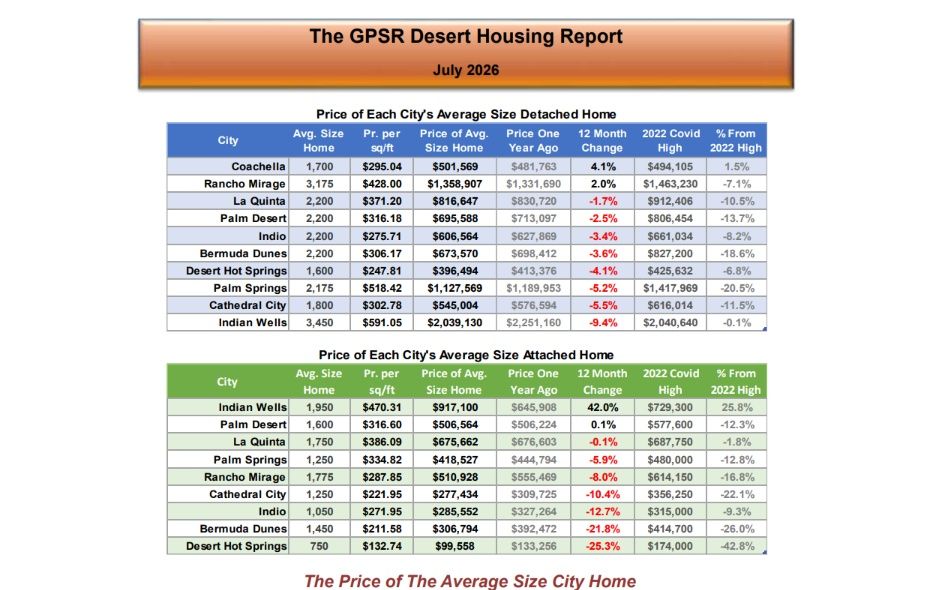
Recent local figures illustrate why neighborhood-level analysis matters. Zillow reported 927 Palm Springs properties for sale and a median listing price of approximately $699,000 at the end of June 2026. Realtor.com reported that Palm Springs homes sold for an average of approximately 2.17% below asking price in June, with a sale-to-list ratio of about 98%. (Zillow)
Separate reporting based on the regional Desert Housing Report found that Palm Springs inventory had declined from the previous year and that the median market time had shortened. However, Coachella Valley sales remained below their longer-term historical norm. (The Palm Springs Post)
Taken together, the data suggests a nuanced market rather than a simple buyer’s market or seller’s market.
Buyers have more negotiating room than they did during the pandemic, but desirable and correctly priced Palm Springs homes can still sell. Sellers should not assume that every listing will receive multiple offers—or that buyers will overlook deferred maintenance, dated finishes or an ambitious asking price.
Palm Springs Homebuyers May Have More Leverage in 2026
For buyers wondering whether 2026 is a good time to buy a home in Palm Springs, the answer depends more on personal circumstances than on trying to identify the exact bottom of the market.
The current environment may benefit buyers who:
Plan to own the property for several years
Have stable income or substantial cash reserves
Can comfortably manage the total monthly housing expense
Are willing to negotiate rather than wait for a dramatic price collapse
Want a larger selection of Palm Springs homes and condos
Are searching during the summer or other less competitive periods
Buyers may be able to negotiate a lower purchase price, seller-paid closing costs, repairs, credits or mortgage-rate incentives. However, those concessions are more likely when a property has been on the market for an extended period or requires improvements.
Turnkey homes in desirable neighborhoods can still command strong prices, particularly when they combine good design, privacy, views, updated systems and compelling outdoor living.
Palm Springs Sellers Need a More Strategic Approach
The 2026 market is less forgiving of overpricing.
During the height of the pandemic market, limited inventory allowed some sellers to test aggressive asking prices. Today’s buyers have more information, more listings to compare and greater sensitivity to both monthly payments and future ownership expenses.
Palm Springs sellers should pay close attention to:
Pricing
The first few weeks on the market are often the most important. A price based on active listings rather than actual comparable sales can cause a home to lose momentum.
Presentation
Professional photography, thoughtful staging, landscaping, decluttering and minor repairs can significantly affect a buyer’s perception of value.
Property condition
Buyers are paying close attention to roofing, HVAC systems, pools, plumbing, electrical panels, sewer lines and energy efficiency. In Palm Springs, the age and condition of major systems can materially influence an offer.
Architecture and story
Architectural homes should be marketed with an understanding of their design, history and original features. Simply listing square footage and bedroom count may fail to communicate what makes a distinctive Palm Springs property valuable.
Flexibility
A buyer may value a closing-cost credit, furniture package, rate buydown or flexible closing date more than a small reduction in the asking price.
New-Home Construction Continues to Face Challenges
The construction side of the housing market remains less encouraging.
The U.S. Census Bureau reported that single-family housing starts were running at a seasonally adjusted annual rate of 895,000 in June 2026, essentially unchanged from May. Total housing starts increased, but much of that improvement came from multifamily construction. (Census.gov)
New single-family home sales were running at an annual rate of approximately 628,000 in June, down an estimated 5.6% from June 2025, although the Census Bureau notes that monthly estimates have wide statistical margins of error. (Census.gov)
Builder confidence also remained weak. The NAHB/Wells Fargo Housing Market Index fell to 34 in July 2026. A reading below 50 means more builders view conditions as poor than good. (National Association of Home Builders)
Builders continue to face high construction costs, financing expenses and affordability constraints. Many are using mortgage-rate buydowns, design upgrades and other incentives to attract buyers.
In parts of the Coachella Valley where new construction competes directly with resale homes, sellers should know which builder incentives are being offered. A resale property may need to compete not only on price, but also on landscaping, location, lot size, upgrades, solar ownership and the absence of additional new-community fees.
Will the Housing Market Be Stronger During the Second Half of 2026?
There are reasonable grounds for cautious optimism, but uncertainty remains.
Several factors could support greater activity:
Buyers are gradually adjusting to mortgage rates in the 6% range.
More homeowners can no longer postpone necessary moves.
Inventory has become more balanced.
National home sales are modestly higher than one year ago.
Home prices remain generally resilient.
Buyers have more opportunities to negotiate.
At the same time, affordability remains difficult, new construction is under pressure and economic or geopolitical developments could quickly affect consumer confidence and mortgage rates.
The second half of 2026 is therefore unlikely to resemble the frantic market of 2021. It may instead become a healthier, more deliberate housing market—one in which realistic buyers and well-prepared sellers can successfully reach an agreement.
What This Means for Greater Palm Springs Real Estate
There is no single national headline that accurately describes every Palm Springs neighborhood or every type of property.
A mid-century modern home in Racquet Club Estates, a condominium in South Palm Springs, a luxury property in Vista Las Palmas and a home in a gated Palm Desert or Rancho Mirage community all compete in different market segments.
That is why local pricing, recent comparable sales and property-specific strategy matter more than broad predictions about whether the housing market will rise or fall.
For buyers, 2026 may provide more choices and negotiating opportunities than were available a few years ago.
For sellers, success will depend on accurate pricing, strong presentation, targeted marketing and a clear understanding of what today’s buyers value.
Work With the Paul Kaplan Group
The Paul Kaplan Group has specialized in Palm Springs and Coachella Valley real estate since 2000, with particular expertise in mid-century modern homes, architecturally significant properties, condominiums, vacation homes and 55-plus communities.
Whether you are considering buying a home in Palm Springs, selling an architectural property, relocating to the Coachella Valley or evaluating the value of your current home, our team can provide a neighborhood-specific market analysis based on current listings, recent sales and local buyer demand.
National trends may shape the overall housing environment, but the best real estate decisions begin with an informed understanding of the local market.
Sources and References
National Association of REALTORS®, June 2026 Existing-Home Sales Report and Housing Snapshot. (National Association of REALTORS®)
Freddie Mac, Primary Mortgage Market Survey, July 30, 2026. (Freddie Mac)
U.S. Census Bureau and U.S. Department of Housing and Urban Development, June 2026 New Residential Construction. (Census.gov)
U.S. Census Bureau and HUD, June 2026 New Residential Sales. (Census.gov)
National Association of Home Builders/Wells Fargo Housing Market Index, July 2026. (National Association of Home Builders)
Zillow, Palm Springs Housing Market Data, June 2026. (Zillow)
Realtor.com, Palm Springs Housing Market Trends, June 2026. (Realtor)
The Palm Springs Post summary of the regional Desert Housing Report, June 2026. (The Palm Springs Post)
Selling Your Home?
Get your home's value - our custom reports include accurate and up to date information.